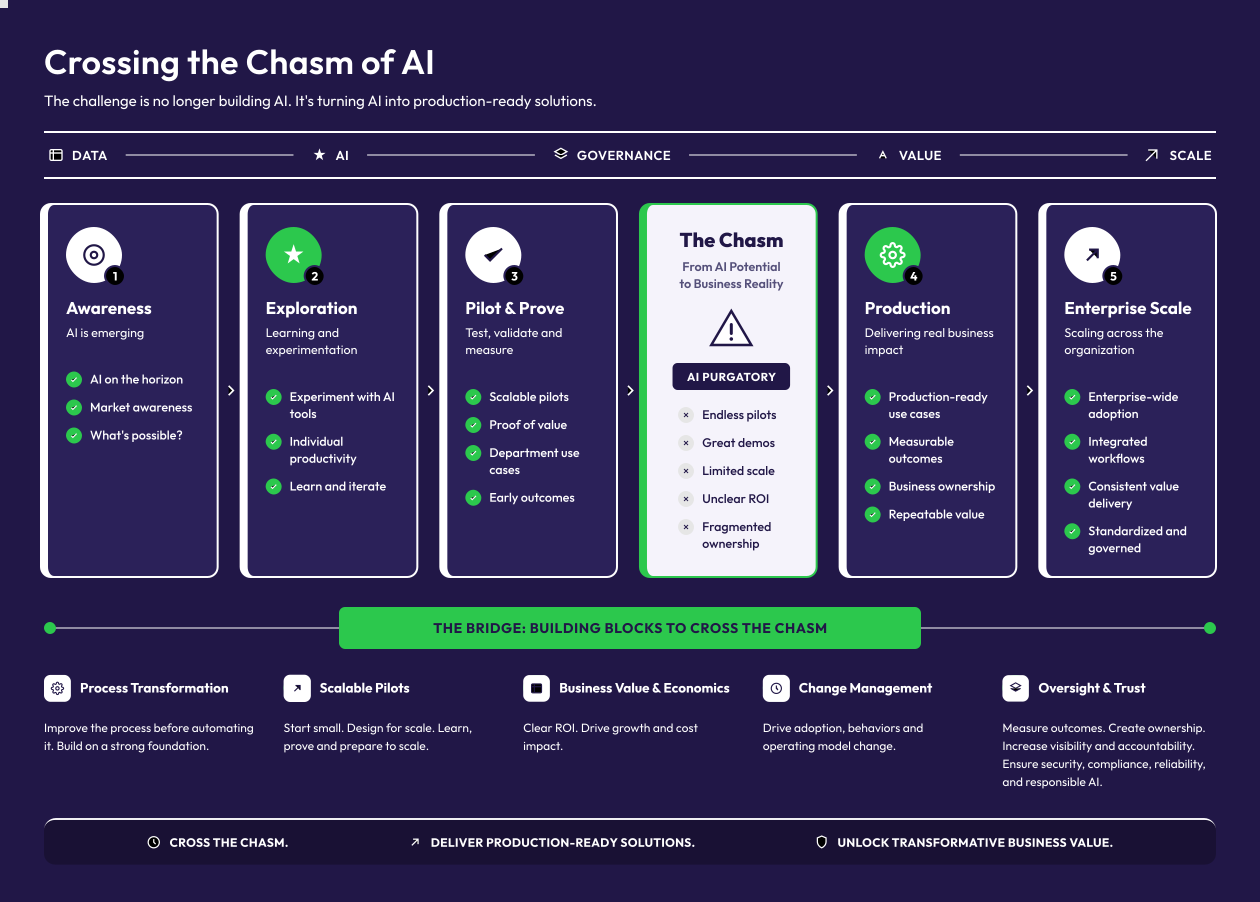
The challenge is no longer building AI. It is escaping the trap of endless pilots that never graduate, and turning experiments into governed, production‑ready solutions that deliver measurable business value at scale.
Why crossing the AI chasm matters now
Investment in enterprise AI is accelerating, but production adoption lags, leaving portfolios stranded in costly, unglamorous pilot purgatory.
Boardroom demos impress yet change no workflows, and leadership can no longer defend the mounting spend.
The organizations that crossover do the unglamorous work first, redesigning the process before automating it.
Governance, ownership, and change management decide production‑readiness, not model sophistication or the size of the budget.
Author Details
Caroline Ritter
AI Strategy and Healthcare Leader, Brillio
Shivangi Jain
Product Manager, Brillio
The illusion of progress
Here is the uncomfortable truth about enterprise AI right now: investment is accelerating, but production adoption isn’t keeping pace. Most organizations have mastered the first three stages of AI maturity: awareness, exploration, and pilot. They have AI on the horizon. They are experimenting. They have scalable pilots, proofs of value, and early departmental use cases. But then they fall into AI purgatory. That stalled state is the chasm: pilots on one side, production on the other, and very few organizations making the crossing. What does that look like from the inside?
Endless pilots that never graduate
Great demos that impress in boardrooms but do nothing in workflows
Limited scale beyond the teams that built the solution
Unclear ROI that leadership can no longer defend
Fragmented ownership where no one is truly accountable for outcomes
The telltale signs are always the same: a growing portfolio of use cases living in PowerPoint, growing fatigue among business stakeholders, and a growing question from the C‑suite: “We’ve spent how much, for what exactly?” The challenge is not building AI but turning it into production‑ready solutions that deliver real business value.
Five building blocks to cross the chasm between pilot and production
Process transformation before automation
Automation applied to a broken process does not fix the problem. It adds another layer of complexity to a process that is already broken. That is the trap most portfolios fall into. The way out is to do the unglamorous work first. The organizations that get this right spend real time with business subject matter experts (SMEs) understanding the current state, identifying failure points and engineering a clean process before a single model touches it. This is the conversation no one wants to have when the pressure is to move fast, but it is also the most important one.
Think enterprise‑wide transformation, not point solutions. AI applied to an isolated step rarely moves the needle; end‑to‑end workflow redesign is what creates compounding value.
The process question always comes before the technology question: what are we actually trying to change, and for whom?
Scalable pilots, designed to grow
There is a difference between a pilot and a production asset, and it is not the quality of the idea. It is the quality of the underlying design decisions. The best pilots are architected from day one to be extended, not rebuilt. They prove value, generate learning, and are structured to scale without starting over.
Build pilots you intend to keep, not throwaway experiments. Architecture decisions made at the pilot stage follow you into production, so make them count.
Treat data access as the bridge between pilot value and enterprise intelligence. In the short term, teams need fast, secure access to relevant data to prove use cases quickly. In the long term, those learnings should feed a governed, reusable data and knowledge foundation that becomes shared intelligence across the organization.
Create reusable architecture patterns to cut testing cycles, approval turnaround times (TATs), build cycles, and tool variability across the organization.
Plan for production maintenance from day one. AI is not ‘deploy‑and‑’ Models can go stale, data patterns can shift, and workflows may need continuous tuning.
Business value and economics, made explicit
Clear ROI is not a finance exercise. It is a strategic discipline. Every AI initiative should have a business owner who can articulate, in plain language, what value it creates, for whom, and by when. If that conversation is uncomfortable, that discomfort is a signal, not a reason to skip it.
Think beyond cost savings. The full value picture includes OpEx reduction, CapEx efficiency, cost avoidance, and opportunity cost: what becomes possible when your people stop doing the work AI can do. Account for the full ‘I’ in ROI. Most business cases stop at the cost to build and ship the code, and that is where organizations get stuck. The investment that determines viability is ongoing: tokenomics at scale, model monitoring and retraining, drift detection, data de‑biasing, and pipeline maintenance. A solution that is cheap to build and expensive to run is not a win. It is a liability you have not priced yet.
Change management as a core workstream
AI initiatives rarely stall in production because of the tech. They stall because adoption, trust, and behavior change were treated as bolted-on afterthoughts instead of first-class deliverables. This means starting the change conversation before the build conversation, not after. One approach we have seen work across organizations is creating guild‑like structures, or AI Competency Centers, that bring together business leaders, change champions, technology leaders, risk and compliance stakeholders, and functional SMEs to drive adoption in a structured way. An AI Competency Center can help by focusing on:
Adoption and change leadership: Identifying impacted users early, addressing concerns around role impact, and helping teams feel like partners in the transformation, not targets of it.
AI literacy and training: Going beyond tool training to help users understand what the AI is doing, where it may fail, when to trust the output, and when to involve a human SME.
Best practices and governance: Defining reusable playbooks, prompt patterns, review standards, responsible AI guardrails, and common adoption metrics across teams.
Knowledge sharing and scale: Creating a forum for teams to share lessons learned, successful use cases, risks, and reusable assets so AI adoption does not remain isolated within one project or function.
Visibility, accountability, and governance as a non‑negotiable investment
Production‑readiness is a design criterion, not a milestone. Furthermore, it’s not a mere technical bar but a governance one. Before anything goes live, someone must be able to answer who owns it, how it is monitored, and what happens when it drifts. That is why governance cannot be an afterthought bolted onto the go‑live plan. It is part of what makes a pilot production‑ready in the first place.
Governance is how you find efficiency, not just control risk. Only a portfolio‑wide view catches the overlaps no single team can: two initiatives solving the same problem, three pulling the same data three different ways. That redundancy is where budgets quietly leak.
It also gives you a common yardstick. When every proposal is framed the same way, on value, cost, and readiness, leadership can compare initiatives and prioritize deliberately instead of funding whichever demo was most persuasive that week.
Accountability must live somewhere structured, or it does not live anywhere. Create the forums to hold it: AI guilds, outcome reviews, steering committees.
Governance should be an enabler, not a gauntlet: a lightweight framework that accelerates the path to production rather than stalling it.
Trust is built through domain understanding, not just guardrails. Knowing where to rely on the model and where to bring in a human SME is what separates responsible AI from reckless automation.
What the full article covers
The five building blocks above are just the method. The complete PDF goes further into what crossing the chasm actually earns you, and how to hold yourself to it:
Why the payoff compounds over time, and how a single production win becomes a differentiator competitors cannot easily copy.
A portfolio self-assessment: if you mapped every pilot and proof of concept today, how many would survive a genuine test of production-readiness?
The one concrete shift chasm-crossers make, funding initiatives by owner, outcome, and path to production, not by demo appeal.
What many organizations get wrong
The instinct is to blame budgets or models. But the organizations that cross over are rarely the best‑funded. They win by doing the unglamorous work: fixing the process, owning the outcome, and treating governance as an enabler rather than a milestone.
What separates the chasm‑crossers
Transform the process before automating it. Automation on a broken workflow only adds complexity to a problem you have not solved.
Architect pilots to scale. Design decisions made on day one follow you into production, so build assets you intend to keep.
Price the full ‘I’ in ROI. Account for run costs, tokenomics, retraining, and drift, not just the cost to build.
Make governance and change management non‑negotiable. Ownership, adoption, and portfolio visibility decide what reaches production.
The questions leaders must ask before committing to the crossing
Ask three questions: is there a named business owner, a measurable outcome, and a design built to scale? If any answer is vague, it is still a demo.
No. A center of excellence often guards standards. A competency center drives adoption, pairing business, technology, risk, and change leaders to move solutions into daily workflows.
Because run economics decide viability. Tokenomics, retraining, and drift detection can dwarf build costs. A solution cheap to build and costly to run is an unpriced liability.
Start with portfolio visibility. Map every initiative against owner, outcome, and readiness. The overlaps and orphans you surface usually fund the first move forward.
Forward-looking thoughts and compelling stories
Blog
Banking and Financial Services
Banking as a Service Adoption – The What and How for Businesses to Reap Benefits