



Blog | Technology | AI and Data Engineering

Three ways to align CDOs and CFOs for faster AI ROI

We look at why AI business cases get lost in translation, stalling enterprise AI investments.

5th May, 2026
element
element

The biggest risk to enterprise AI programs isn't the tech. It's the lack of conversation between the teams building it and the executives funding it.

A shared language of value aligns technical output and financial ROI

  • A tale of two scorecards: CDOs focus on inputs like model accuracy and pipeline reliability, while CFOs demand outputs like revenue growth and cost reduction.
  • The efficiency trap: Technical teams often celebrate operational efficiencies that fail to map to the CFO’s strategic mandate, leading to defunded programs.
  • Strategic misalignment costs: As AI investments grow and board-level scrutiny intensifies, failing to connect technical capabilities with financial returns guarantees program failure.
  • A designed bridge: Alignment requires structural changes, including mapping initiatives to financial outcomes, building metric bridges, and establishing an AI value council.
Author Details
Prakash TM

Senior Director – Strategy and Consulting, Brillio

Bridging the gap between capability and return: Here’s the reality

Many enterprise AI pilots never reach production despite technical success. Why? Because CDOs and CFOs are measuring success against entirely different goalposts. Bridging this gap is the secret to sustained AI funding and growth. In the push to implement enterprise AI, a concerning pattern emerges across organizations: the CDO and the CFO sit in the same room, look at the same initiative, and arrive at completely different conclusions about its success.

Both rely on real data. Both believe they are rigorous. Yet, they measure entirely different things. This misalignment is not a new problem, but as AI investments increase and board members demand clear returns, the cost of this disconnect compounds fast. The failure is rarely technical. It is almost always a breakdown in how value is defined, measured, and communicated.
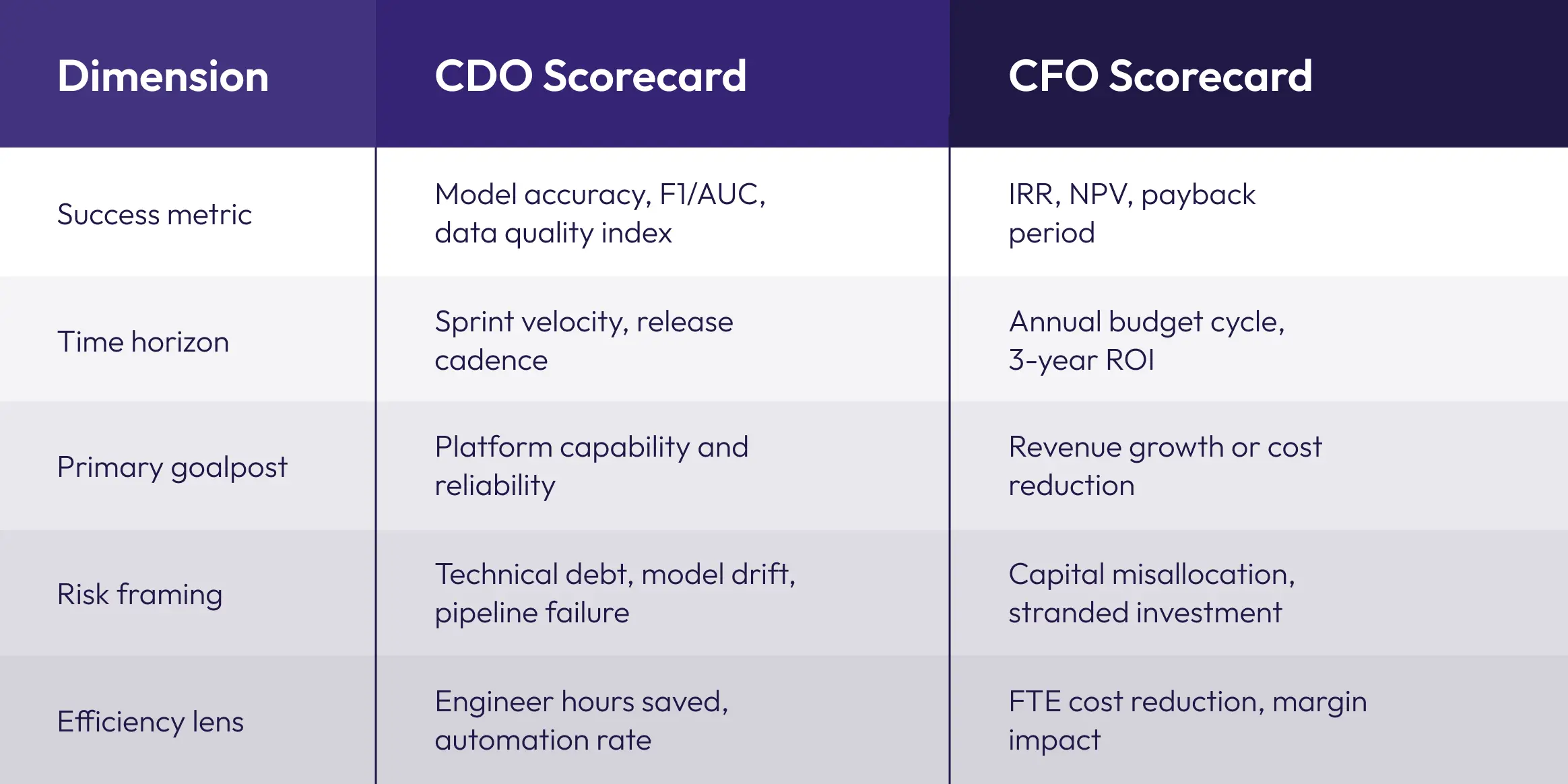

Two scorecards, two realities

The CDO’s world is built around inputs: data quality, model accuracy, pipeline reliability, and automation rates. A well-governed data platform is the essential foundation. However, these metrics are largely invisible on the income statement. The CFO’s world is built around outputs: revenue per customer, cost per transaction, margin contribution, and payback periods. These are the strategic metrics that determine whether a program receives funding in the next planning cycle or gets quietly rationalized.

The deeper issue is the goalpost. CDOs optimize for capability: what the AI platform can do. CFOs optimize for return: what it has demonstrably delivered. Without a structured bridge between these two orientations, even technically excellent programs cannot justify continued investment.

Three ways to align CDOs and CFOs for faster AI ROI

Before scoping any AI program, define the CFO-visible outcome it maps to; not ‘improve data quality’ but ‘reduce cost-to-serve by 8%’. Every technical metric is then calibrated against said yardstick.

Build a metric bridge document for every technical metric the CDO tracks. For example, model accuracy → recommendation relevance → conversion rate lift. Pipeline latency → decision speed → revenue per customer per cycle. This is not an academic exercise but a governance artifact reviewed in executive QBRs.

A standing governance forum with joint CDO and CFO representation that reviews AI initiatives through both lenses: technical health and financial trajectory. Investment decisions are made here, not just build decisions.

Beware the efficiency trap with AI initiatives

If the CFO's mandate is growth or churn reduction, mere ‘efficiency gains’ like automation or reduced processing time miss the strategic mark. The CDO may celebrate a 15-point improvement in model accuracy while the CFO watches EBITDA plateau. Result? The initiative inevitably gets rationalized away at the next budget review.

Make enterprise AI value stick with the following considerations

  • Every AI initiative must map to a specific, CFO-visible financial outcome. Not a broad value category, but a named metric with a defined number.
  • The CDO and CFO should share a closely aligned definition of AI success for the coming year. If their views differ significantly, alignment likely needs work.
  • AI program OKRs should be jointly owned across CDO and CFO functions, with shared accountability rather than siloed responsibility.
  • A clear RACI across CDO, CFO, and business unit leaders is essential, so ownership does not disappear when results are scrutinized.
  • Teams should be willing to stop AI initiatives that don’t support strategic priorities, rather than continuing them simply because the technology is interesting.

Forward-looking thoughts and compelling stories

Blog

  • Technology

Beyond the model: Why architecture is your real AI edge

Beyond the model: Why architecture is your real AI edge Read more  

Thought Leadership

  • Technology

Beyond the Curve 2026: From AI promise to P&L impact

Beyond the Curve 2026: From AI promise to P&L impact Read more  

Case Study

  • Hi-Tech

Engineering Performance at Speed with an AI-Ready Digital Backbone for Atlassian Williams F1 Team

Engineering Performance at Speed with an AI-Ready Digital Backbone for Atlassian Williams F1 Team Read more  
ai driven healthcare

Case Study

  • Life Sciences

AI-Driven Healthcare Transformation: Revolutionizing Disease Detection with Deep Neural Networks for Improved Patient Outcomes

AI-Driven Healthcare Transformation: Revolutionizing Disease Detection with Deep Neural Networks for Improved Patient Outcomes Read more  

You define the north star, We pave the digital path

Let's connect   
elements
elements