



And the market agrees. Projected to grow at more than 60% annually over the next five years, digital twins are moving from manufacturing floors into retail operations, life sciences development, city infrastructure, and financial services. The technology is ready. The data already exists. The only remaining question is whether organizations will act on what their twins reveal.
Today’s Use Cases for Digital Twins
Digital twins aren’t just for the factory floor anymore. Any entity that generates data, a person, a process, a physical asset, can be mirrored virtually. That opens the door to enterprise ai applications across virtually every function a business runs.
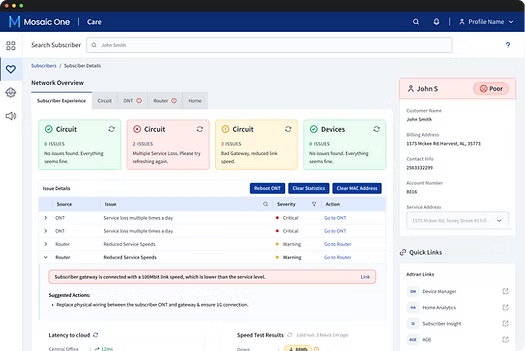
Take contact center optimization. A twin can model the interactions among agents, digital tools and customer segments to expose staffing inefficiencies that gut feel would never surface. Pair that with ai digital transformation consulting, and the decisions that come out of that model are grounded in live operational data, not historical averages.
Customer experience is another front. Twins of individual consumer personas let companies simulate full journeys before committing to any design change, the kind of capability that sits at the intersection of generative AI and enterprise ai solutions. Product teams benefit too: continuous simulation of new features can reveal downstream effects on service load and monetization before a single line of code ships.
Supply chain is where the combinatorial power really shows. Link production twins to inventory twins to supplier twins, change one variable, and watch the ripple. ESG compliance follows a similar logic, modeling emissions across a full value chain is exactly the problem digital twins solve, and it’s one where hi-tech digital solutions and ai engineering services are converging fast.
The pattern across all these cases is consistent. Replace assumption with simulation. Replace trial-and-error with evidence. The full picture of how these use cases scale, and what it takes to build toward them, goes considerably deeper.
De-risk decisions with twins
Poor operational decisions cost enterprises an estimated 3% of annual profits, and that’s not abstract math. It shows up in bloated contact centers, misallocated headcount, and digital tools deployed to the wrong audiences. The real question isn’t whether your organization makes bad calls, it’s whether it keeps making them without knowing why.
Digital twins change the calculus entirely. By building a live, data-fed replica of a business process, enterprises can test interventions before committing a dollar or displacing a single workflow. That’s not a simulation in the traditional sense. It’s decision-making with actual operational data as the substrate.
Consider what this looks like in practice. A leading health insurer wanted to improve its healthcare member experience without inflating contact center costs. The challenge: knowing which levers to pull first. Adding human agents? Deploying enterprise AI chatbot solutions? Targeting specific member segments with proactive outreach? Each option carried real cost and real risk. The digital twin consumed live data on call volumes, agent performance, call deflection rates, and member types, then ran those scenarios virtually. The right choices became visible before any commitment was made.
What makes this approach distinct from conventional digital transformation consulting is the feedback loop. As the contact center evolves, so does the twin. Every change updates the model, and the model keeps informing the next decision. That’s not a one-time engagement. It’s a continuous enterprise AI solution with compounding returns, built to accelerate, and engineered to deliver.
Twins Take on Time and Space
Real-world constraints don’t have to constrain real-world decisions. Time, terrain, safety risks, resource limits, digital twins dissolve all of it, giving enterprises a way to think and act at a scale that physical experimentation simply can’t match.
Consider what this means for a large cellular carrier working to future-proof its mobile network. Environmental changes, new construction, growing trees, temperature swings, quietly degrade network performance, nudging customers toward competitors. Dispatching crews to monitor every variable isn’t practical. But a digital twin of the network and its surroundings? That can model tree growth trajectories over years, forecast how rising temperatures stress cell tower equipment, and surface degradation risks well before customers notice them.
The implications extend far beyond telecom. Any enterprise wrestling with ai digital transformation challenges tied to physical complexity, from energy infrastructure to hi-tech digital solutions spanning multi-site operations, gains something genuinely valuable here. Digital twins let teams accelerate time, compressing months of potential change into a model that runs in hours. They expose when to upgrade systems, schedule maintenance, or reroute capacity before a crisis forces the issue.
This is where enterprise ai solutions stop being theoretical. The twin becomes a living forecast, continuously updated by real data, continuously narrowing the gap between what a business plans and what actually happens. Decisions that once required years of observation can be validated virtually first, then implemented with confidence.
The restaurant and the metaverse
Think about what it actually takes to guarantee that a burger arrives fresh, ethically sourced, and on time. Farms, freight routes, cold storage, dozens of supplier relationships. For a quick service restaurant chain committed to a genuine farm-to-fork philosophy, that complexity is the daily reality of doing business right. The question was how to test its resilience without putting real operations at risk.
Working with Brillio, the chain built a digital twin spanning warehouses, transportation networks, and physical restaurant locations across its footprint. The twin didn’t just map current operations. It stress-tested them. By simulating scenarios where key suppliers couldn’t ship produce, poultry, or other staples, the system surfaced which supply chain gaps posed the biggest threat to the brand promise. Decisions about which suppliers to contract became data-based, not instinctive.
But the more revealing part is what comes next. A twin like this doesn’t stay static. Gradually, it can absorb weather data, labor forecasts, regional demand signals, and farm-level production inputs, building toward a living model of the company’s entire operating environment. That’s the foundation of an enterprise metaverse: interconnected digital twins that, when combined with generative AI and machine learning, allow an organization to analyze its own world and act before problems become expensive. Companies serious about digital transformation consulting, sustainable supply chains, and enterprise AI solutions are already thinking this way. The restaurant was simply ahead of the curve.
The time for twins is now
Every enterprise AI initiative eventually faces the same question: what do you do with all the data you’ve collected? Digital twins answer it by putting that data to work in ways that compound over time. Start with one process, one contact center, one supply chain node. The twin grows as the business grows, absorbing new data sources, new AI and ML models, new use cases that weren’t even on the roadmap when the first virtual replica went live.
That compounding effect is what separates early movers from the rest. Organizations already deep in digital transformation consulting and enterprise AI solutions aren’t just solving today’s operational problems. They’re building institutional intelligence that gets sharper with every decision cycle. Competitors who wait inherit a gap that only widens.
The industries seeing the sharpest early results share one trait: they treat digital twins not as a standalone technology experiment, but as a layer of their broader AI and data engineering capability. Healthcare payers model member journeys. Retailers simulate supply disruptions before they happen. Hi-tech companies pressure-test new product configurations against real demand signals. In each case, the twin doesn’t replace human judgment. It makes that judgment far better informed.
Building one doesn’t require a perfect data estate on day one. Layer in telemetry as it becomes available, connect systems through open APIs, and design for iteration. The organizations that start now, even imperfectly, will be the ones making smarter moves three years from now while others are still debating where to begin.